
Your Calibration Lab Deserves Better Than Excel
Over 90% of operational spreadsheets contain errors, and labs that move to structured systems report 45% lower operating costs, 78% fewer human errors, and up to 50% faster throughput.
If your calibration workflows still live in Excel, you're paying an invisible tax in rework, risk, and wasted technician time. Here's why — and how to fix it.
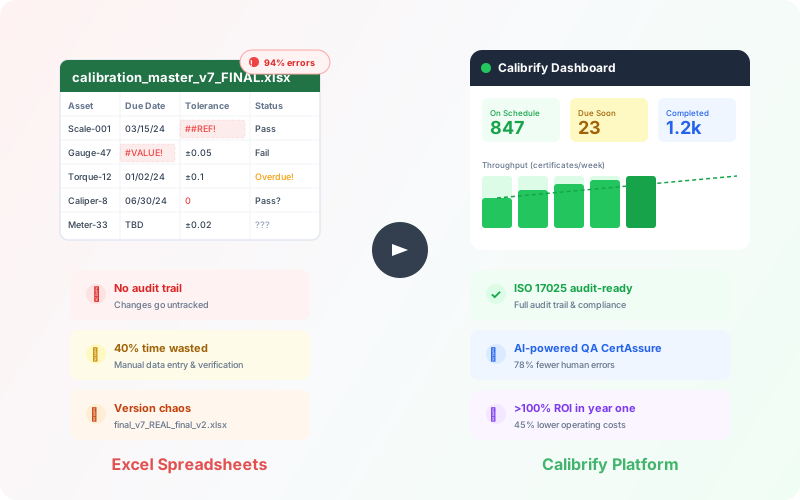
94%
of spreadsheets contain errors
Panko research
45%
lower operating costs after switching
Industry average
78%
fewer human errors
Lab digitization studies
>100%
ROI within the first year
CMS implementation data
The Spreadsheet Error Epidemic
Professor Ray Panko's research across multiple field audits found that about 94% of spreadsheets used in operations contain errors. For a calibration lab living and dying by traceability and accuracy, this is not a theoretical inconvenience — it is a structural risk.
Formula Errors Everywhere
1-5% cell error rateCopy-paste mistakes break hidden formulas. Reference ranges silently exclude new rows. Hard-coded values bypass uncertainty and tolerance logic. In calibration, a single wrong cell means wrong pass/fail decisions.
No Audit Trail
Zero traceabilityA technician can fix a number retroactively with no trace. Excel lacks immutable logs, role-based access, and electronic signatures -- all required by ISO/IEC 17025 and demanded by auditors.
40% of Your Time -- Gone
30-40% capacity lostManually updating due dates, copying readings between tabs, rebuilding pivot tables before audits, and hunting for the right version of a certificate. Your technicians become part-time spreadsheet admins.
Version Chaos
Fragmented recordscalibration_master_final_v7.xlsx becomes a game of roulette. Certificates, raw data, and uncertainty budgets live across separate files and folders, making it nearly impossible to prove traceability.
ISO 17025 Non-Conformities
Compliance riskUncontrolled spreadsheets are a recurring source of non-conformities during accreditation audits. Excel cannot enforce structured workflows for review, approval, or decision rules required by ISO/IEC 17025:2017.
Hidden Costs Compound
Revenue at riskMiscalibration from spreadsheet errors leads to increased scrap, rework, product recalls, production downtime, equipment damage, and legal penalties. These costs dwarf any free-tool savings.
“When someone builds a spreadsheet, they will make errors in about 1–5% of all cells… Spreadsheets are big — you're almost certainly going to have bottom-line error.”
— Ray Panko, Professor & spreadsheet error researcher
Why This Is Especially Dangerous Under ISO/IEC 17025
ISO/IEC 17025:2017 requires a risk-based approach to decisions and records, including evaluation of measurement uncertainty and documented decision rules. Excel, out of the box, fails every requirement:
- No immutable audit log — technicians can alter records retroactively
- No role-based access control or electronic signatures
- No structured workflows for review and approval
- No enforced decision rules for conformity assessment
- EUROLAB warns: naïve spreadsheet use in accredited labs is risky
Hidden Costs of Poor Calibration Records
How Calibrify Replaces the Spreadsheet Chaos
Calibrify is designed from the ground up to address every weakness of Excel in calibration labs — combining calibration management, analytics, and AI-driven QA into a single auditable platform.
Single Source of Truth
Central asset register with complete digital history — owner, location, procedures, and all past calibrations. Automated status tracking replaces hours of folder-slogging.
Built-In ISO 17025 Compliance
Structured workflows that mirror accreditation requirements, integrated uncertainty management, and immutable audit trails. Auditors see exactly what they need.
AI-Powered QA CertAssure
Automatically ingest certificates, check for typos, consistency errors, and mathematical accuracy. Validate compliance with lab-specific rules. 70% faster issue detection.
Analytics & Dashboards
Real-time dashboards for throughput, error rates by technician, location, and customer. Data-driven decisions instead of gut feelings and fragile pivot tables.
Customer Portals & Recall
Give customers real-time status visibility. Automated recall management ensures no instrument falls through the cracks. Digital experience that sets you apart.
Integration & Scalability
Connect to ERP, accounting, and quality systems. Cloud or on-premise. Scale from one site to many without processes hidden in personal spreadsheets.
Excel vs Calibrify — Feature-by-Feature
A practical comparison across the dimensions that matter most for calibration lab operations, compliance, and growth.
| Capability | Excel | Calibrify |
|---|---|---|
| Error rate in records | 1–5% per cell (94% of sheets have errors) | Validated inputs, automated checks, near-zero |
| Audit trail | None — changes are invisible | Immutable, timestamped, role-based |
| ISO 17025 decision rules | Manual, undocumented formulas | Built-in, auditable workflows |
| Uncertainty budgets | Fragile formulas across tabs | Automatic per-test-point GUM-style budgets |
| Certificate QA | Manual human review only | AI-powered + human review (70% faster) |
| Due-date tracking | Manual column checks | Automated alerts & recall management |
| Multi-user editing | Conflict-prone, overwrite risks | Concurrent, role-based access control |
| Customer visibility | Email attachments | Real-time customer portal |
| Scalability | Breaks at ~50+ instruments | Built for 100s to 1,000s of assets |
| Time to audit-readiness | Days of prep work | Always audit-ready |
The ROI of Leaving Excel Behind
Industry analyses consistently show that calibration management systems deliver strong financial returns — often exceeding 100% ROI within the first year when labor savings, downtime reductions, and compliance cost avoidance are factored together.
- Automation reduced downtime by 20% for manufacturing companies
- Labs reallocated 20–30% of staff time from admin to value-added tasks
- AI-powered QA achieves 300–400% ROI within 18–24 months
- Fewer non-conformities and associated corrective actions
- Significant reductions in time preparing for audits
Why ROI Is Even Better at Scale
Error probability grows with complexity
Excel error rates compound as workbooks, formulas, and tabs multiply.
Coordination overhead grows disproportionately
More sites, technicians, and instruments multiply manual effort exponentially.
Audit frequency increases with scale
Larger labs face more stringent audits — automation saves more time and reduces more risk.
Mid-size and large labs are in the “sweet spot” where moving beyond Excel unlocks triple-digit ROI.
Your Competitors Are Already Moving
Labs that digitize early deliver faster, more reliable service at lower cost. The ones still in Excel can't keep up.
45%
reduction in operational costs after moving from Excel to structured lab systems
78%
fewer human errors with validated inputs and automated checks
50%
faster throughput — certificates out the door in half the time
The real FOMO isn't about the latest buzzword tool — it's about missing out on the productivity, compliance confidence, and financial gains that labs elsewhere are already banking by leaving Excel behind.
Frequently Asked Questions
Is Excel really that bad for calibration?
Excel is a powerful general-purpose tool, but it was never designed for regulated calibration workflows. Research consistently shows 88–95% of operational spreadsheets contain errors. In calibration, a single formula mistake can mean wrong pass/fail status, wrong uncertainty, and wrong decisions about instrument fitness.
We're a small lab — can we stay on Excel a bit longer?
For a handful of instruments with one owner and simple cycles, Excel may work. But the moment multiple people edit the same sheet, due dates are checked manually, or certificates live across folders and inboxes, you're accumulating risk and hidden costs. The earlier you switch, the smoother the transition.
How long does migration take?
Most labs are up and running on Calibrify in days, not months. We help you import existing asset data and certificates so there's no painful gap in your records.
What about our existing calibration software?
Calibrify can work alongside or replace your legacy system. Our Turbocharge module lets you add AI-powered QA and modern features to your existing setup without a full migration. See our Turbocharge page for details.
What ROI can we expect?
Industry data shows calibration management systems regularly deliver over 100% ROI in the first year. With Calibrify's AI-based QA CertAssure, labs that issue thousands of certificates per year see even higher returns.
Does Calibrify meet ISO/IEC 17025 requirements?
Yes. Calibrify is designed with ISO/IEC 17025-ready workflows, immutable audit trails, role-based access, uncertainty management, and decision rule support. It addresses every gap that Excel has under accreditation requirements.
Ready to Leave Excel Behind?
See how Calibrify can save your lab time, protect your reputation, and deliver audit-ready workflows from day one. Book a personalized consultation to get a custom ROI analysis for your operation.
Still running on Excel?
Let us show you what your lab looks like on Calibrify. Free ROI analysis included.
Contact Us